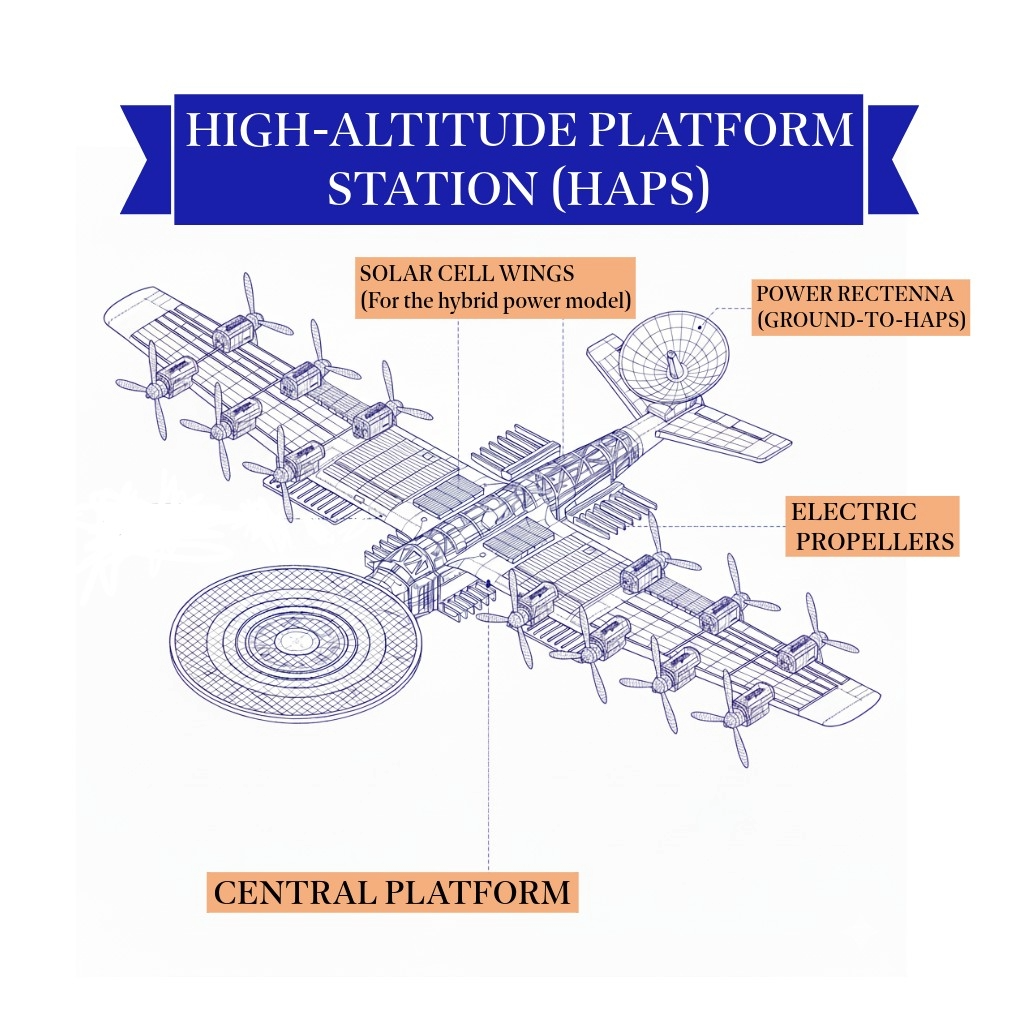
CONCEPTUAL BLUEPRINT:THE HAPS LADDER
This is the simple, brilliant solution to getting power to space safely. Instead of one massive, high-risk beam, we use a two-step "ladder". Step 1: A low-intensity beam is sent 20km up to a High-Altitude Platform Station (HAPS). Step 2: The HAPS, flying above 95% of the atmosphere, re-transmits the power safely the rest of the way to orbit. This avoids atmospheric breakdown and turns a physics problem into a simple engineering one.
This blueprint uses a hybrid model, with solar panels for redundancy and a small rectenna that "sips" a tiny fraction of the beam's power. This allows the HAPS to stay powered 24/7 for years, not just months, which is key to the global grid.
A Note for HAPS Innovators: This beam-powered architecture is also a valuable concept on its own. As a freely-offered idea, HAPS companies might consider how a ground-powered rectenna could allow them to build lighter, non-solar platforms that are no longer limited by battery life, enabling 24/7, persistent operations for all their services.