
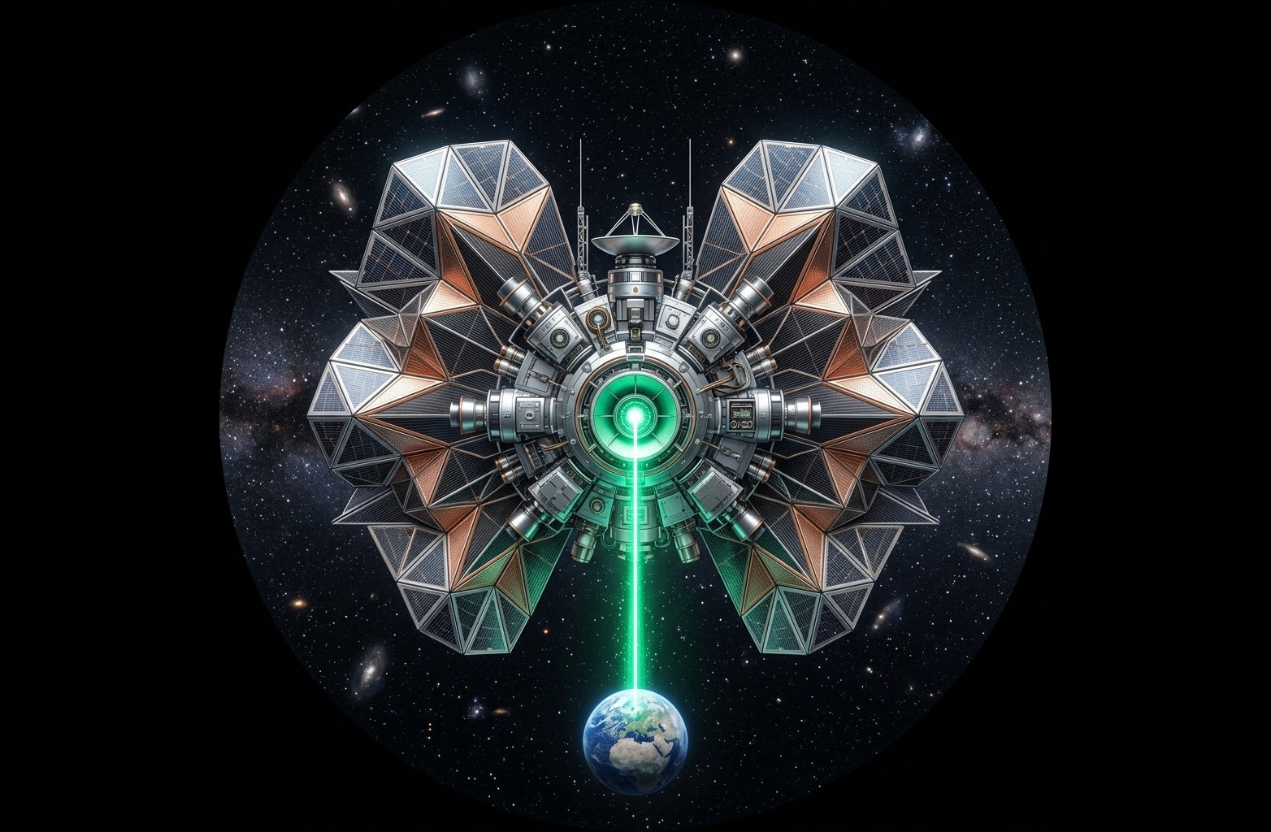
A pragmatic, phased strategy for developing a national-scale wireless power grid. This blueprint details how to connect proven, high-output Enhanced Geothermal Systems (EGS) to the existing national power grid using a "stratospheric bridge." By utilizing a network of High-Altitude Platform Stations (HAPS) to relay energy to retrofitted fossil-fuel plants, this architecture outlines a de-risked, highly viable path to national energy independence without the immense cost of space-based infrastructure.
THE DIRECT PATH
A pragmatic roadmap for a global clean energy network, connecting "stress-tested," high-readiness technologies into a revolutionary new architecture.
Disclaimer & Clarification
The "Direct Path" is a conceptual framework and feasibility plan developed by systems researcher Sarah Jo Cooper.
All blueprints and diagrams on this page are conceptual models created for illustrative and inspirational purposes only. They are not formal engineering schematics.
References to real-world organizations highlight the groundbreaking work that makes this plan feasible. This project is not affiliated with, endorsed by, or in partnership with any of these organizations. All trademarks belong to their respective owners.
01. The "Why": Solving a Shared Crisis
This project began with a single, driving question: How can we solve our planet's energy crisis and its pollution crisis at the same time?
It is estimated that 8 million people die prematurely every year from air pollution. This isn't a distant problem; it is a silent pandemic that affects us all. The sky has no borders. This is a shared crisis that demands a shared, scalable solution.
This feasibility plan, "The Direct Path," is offered as that solution.
The Fictional Spark
To inspire the generation that will inherit this infrastructure, these concepts were originally introduced in the young adult novel, "10,000 Reasons Why It Might." Following a young visionary in Hawaii, the story acts as a "real-world service fiction," wrapping heavy logistical science inside a narrative to empower youth to look toward the future.
02. The "What": A 3-Step Architecture
While real-world projects have proven the individual components, the "Direct Path" provides the novel architecture that links them into a single, viable, global network.
THE HYBRID FURNACE (The Source)
Combining baseload geothermal power with supplemental solar arrays to create a stable, 24/7 continuous energy supply for ground-to-air transmission.
THE HAPS LADDER (The Uplink)
Bypassing the atmosphere's "plasma shield" constraints by utilizing High-Altitude Platform Stations (HAPS) as stratospheric relay nodes to safely step power up to orbit.
THE GLOBAL HUB (The Relay)
A geostationary relay satellite network designed to catch the stratospheric beam and precisely distribute clean energy to targeted receiver stations anywhere on Earth.
Want to see how it works?
The mechanical logistics of Microwave Power Transmission (MWPT), payload specifications, rectenna architecture, and full system schematics are detailed exclusively in the complete Direct Path Technical Blueprint PDF.
03. The Future Potential
Subscription-Based Directed Energy for Logistics
The profound impact of this architecture extends far beyond grid power. By establishing a reliable, space-based directed energy network, we unlock the potential for entirely new commercial and residential infrastructure.
Imagine a future where heavy logistics fleets and decentralized housing nodes are powered directly from the stratosphere—eliminating grid dependency, reducing environmental costs, and creating a multi-billion dollar revenue model for clean energy providers.