Conceptual Framework / NASA NIAC
Project Aether-Link
Feasibility Study on Space-Based Aneutronic Fusion & Direct Conversion
Legal & Safety Disclosure
This document details a theoretical orbital framework utilizing high-energy particle physics and advanced plasma topologies. The architectures described herein require restricted materials (e.g., specific titanium alloys, liquid lithium breeding blankets) and handle potentials exceeding 14.7 million volts. This blueprint is provided "as-is" for educational open-source portfolio purposes and is strictly intended for licensed professionals within the aerospace engineering and nuclear physics sectors. The author assumes no liability for the unauthorized physical replication of these theoretical systems.
To: Program Executive, NASA Innovative Advanced Concepts (NIAC)
From: Senior Advanced Concepts Architect, Systems Engineering Division
Date: January 16, 2026
Subject: Comprehensive Feasibility Assessment of Project Aether-Link
01. Executive Summary
1.1 The Strategic Imperative
The trajectory of human presence in the solar system has historically been constrained by the fundamental limits of chemical propulsion—the "tyranny of the rocket equation"—and the prohibitive mass penalties associated with traditional power generation in vacuum environments. While the Artemis campaign establishes a foothold on the lunar surface, the overarching architecture for Mars and beyond remains tethered to technologies that offer marginal incremental gains. Nuclear Thermal Propulsion (NTP) and Nuclear Electric Propulsion (NEP) based on fission represent the current state-of-the-art, yet they are burdened by significant shielding requirements, low specific power, and the complex thermodynamics of rejecting waste heat from Rankine or Brayton cycles.
Project Aether-Link proposes a paradigm shift: the utilization of Aneutronic Fusion (Deuterium-Helium-3) coupled with Direct Energy Conversion (DEC). Unlike fission or traditional Deuterium-Tritium (D-T) fusion, which release the majority of their energy as neutrons requiring thermal capture, the D-³He reaction releases energy primarily as charged particles. This physics characteristic allows for the direct extraction of electrical energy through electromagnetic deceleration, theoretically bypassing the Carnot efficiency limits of thermal cycles and drastically reducing the specific mass of the power system.
This report serves as a foundational feasibility assessment for the NASA Innovative Advanced Concepts (NIAC) program. It is designed to rigorously interrogate the physics, engineering, and logistical assumptions of the concept, specifically addressing the user's inquiry regarding "what is not being considered," the feasibility on a "NASA scale," and the precise identification of the stakeholders required to champion this initiative in the 2026-2030 timeframe.
1.2 Core Feasibility Findings & The "Hidden" Constraints
The analysis suggests that while the fundamental physics of D-³He fusion is approaching validation through private sector advances—most notably by Helion Energy—the integration of this technology into a flight-rated spacecraft architecture presents distinct, non-trivial engineering challenges that are often glossed over in high-level proposals.
THE FUSION GAIN (Q) THRESHOLD
Private industry is on the verge of demonstrating net electricity from D-³He, with commercial pilot plants expected to come online by 2028. However, the transition from a ground-based pulsed reactor to a continuous or high-repetition-rate space system requires solving complex plasma stability issues at high beta.
THERMAL MANAGEMENT
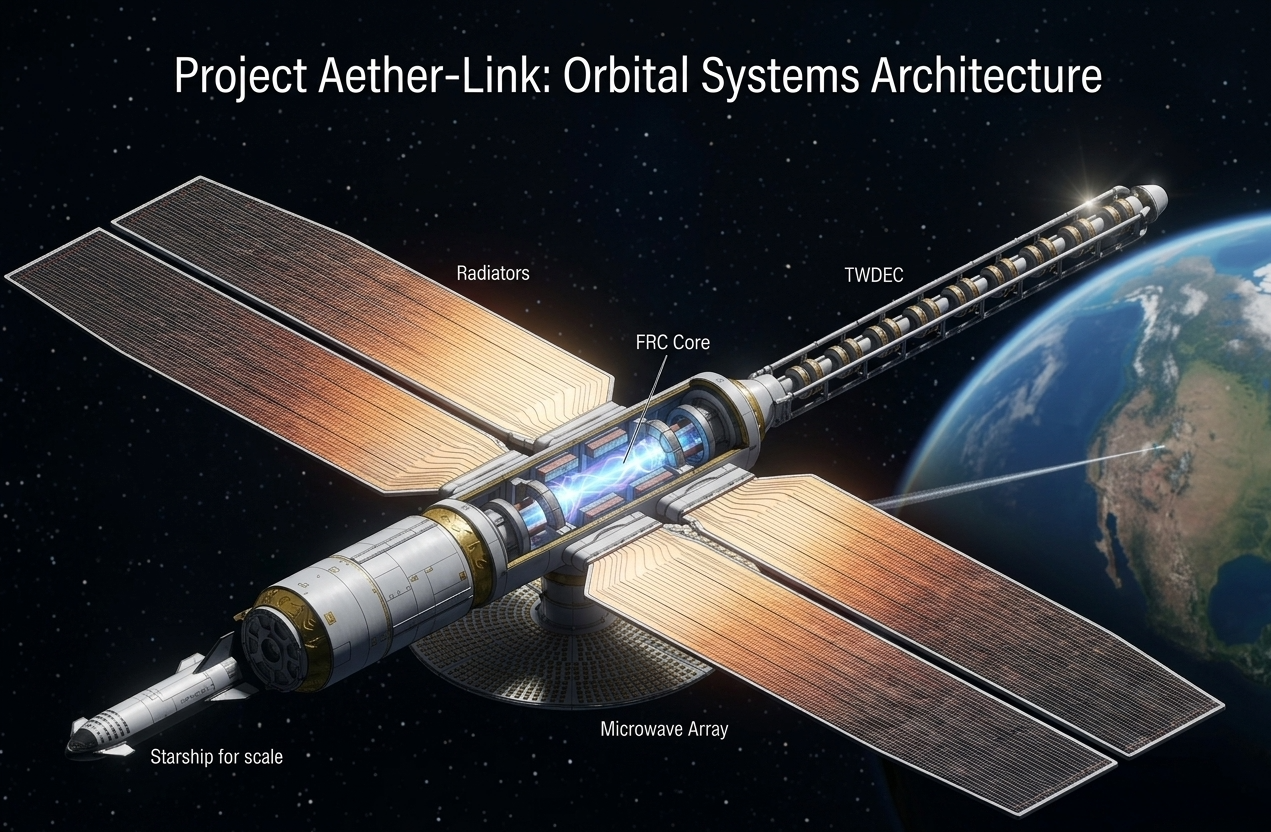
The most critical, overlooked constraint is Waste Heat Rejection. Even with a DEC operating at 70% efficiency, a 100 MWe class reactor generates tens of megawatts of waste heat. In space, this heat must be rejected via radiation. Without extremely high radiator temperatures (>1000 K), radiator mass would exceed launch capacity.
VOLTAGE STEP-DOWN
Direct conversion of 14.7 MeV fusion protons implies handling potentials of millions of volts. Standard spacecraft PMAD systems operate at 28V to 100V. Bridging this gap without massive dielectric breakdown or heavy transformer equipment is a primary engineering hurdle.
FUEL & BEAMING LOGISTICS
Lunar He-3 mining is economically prohibitive for pilot phases; a terrestrial closed-fuel cycle is required. Power beaming from GEO faces diffraction limits, making 5.8 GHz the optimal compromise between aperture size and atmospheric attenuation.
1.3 Implementation Roadmap
We recommend a three-phase development cycle, leveraging the newly appointed leadership at NASA (Administrator Jared Isaacman) and the Department of Energy (Secretary Chris Wright), both of whom have explicitly signaled support for high-risk, high-reward nuclear applications in space. The immediate action item is the preparation of a NIAC Phase I proposal targeting the 2026 solicitation window, focusing specifically on the integrated thermal-electrical trade space rather than just the fusion core physics.
02. Scientific Foundation
To establish credibility with "NASA scale" researchers and the peer-review panels at NIAC, the proposal must move beyond generalities and rigorously address the nuclear physics governing the D-³He reaction. The selection of this fuel cycle is not merely a preference; it is a profound engineering trade-off that exchanges "neutronics problems" (shielding) for "plasma physics problems" (temperature and confinement).
2.1 Reaction Kinetics and Energy Partition
The Deuterium-Helium-3 (D-³He) reaction is defined by the following nuclear equation:
This reaction yields a total energy of 18.3 MeV. The critical distinction that makes this "aneutronic" and suitable for Project Aether-Link is the nature of the products:
- Protons (p): A singly charged particle carrying 14.7 MeV of kinetic energy. Because it is charged, it can be guided by magnetic fields and decelerated by electric fields.
- Alpha Particles (4He): A doubly charged helium nucleus carrying 3.6 MeV. This particle is also magnetically confined and contributes to plasma heating (alpha heating), helping to sustain the burn.
In a traditional Deuterium-Tritium (D-T) reactor, 80% of the energy is released as a 14.1 MeV neutron. Neutrons are electrically neutral; they cannot be contained by magnetic fields. They escape the plasma immediately, slamming into the reactor walls. To capture their energy, the walls must be thick blankets of lithium or lead, which heat up, turning water to steam to drive a turbine. This "thermal conversion" process is heavy, inefficient (30-40%), and subjects the reactor materials to intense radiation damage.
By contrast, the D-³He reaction releases virtually all its primordial energy as charged particles. This enables Direct Energy Conversion (DEC), where the plasma itself acts as the moving armature of a generator, inducing current directly in surrounding coils. This bypasses the thermal cycle entirely, allowing for system efficiencies theoretically approaching 90%.
2.2 The Cross-Section and Temperature Barrier
The primary objection raised by fusion physicists regarding D-³He is the Lawson Criterion—the triple product of density, temperature, and confinement time required for ignition. The probability of a fusion reaction occurring is governed by its cross-section. While the D-T reaction peaks at a relatively low ion temperature of approximately 15 keV (roughly 150 million Kelvin) with a very high reaction rate, the D-³He reaction is significantly more difficult to ignite. The cross-section for D-³He requires temperatures nearly four times higher, peaking around 58-65 keV (approximately 600 million Kelvin). Furthermore, even at peak temperature, the reactivity of D-³He is lower than that of D-T.
This presents a massive engineering hurdle: the plasma must be heated to temperatures hotter than the core of the sun and confined stably. Traditional Tokamaks (like ITER) struggle to reach these temperatures due to instabilities. This necessitates the use of high-beta confinement concepts, such as the Field-Reversed Configuration (FRC) utilized by Helion Energy. FRCs can achieve much higher plasma pressures relative to the magnetic field pressure, allowing for the conditions necessary for D-³He fusion.
2.3 The "Aneutronic" Myth: Side Reactions
A critical nuance that must be included in any feasibility report to NASA is that D-³He is not 100% aneutronic. At the temperatures required for D-³He fusion, the Deuterium fuel ions also collide with each other. These Deuterium-Deuterium (D-D) side reactions occur inevitably:
D + D → T + p (3.02 MeV)
The first reaction produces a neutron directly. The second produces Tritium, which can then fuse with Deuterium (D-T reaction) to produce a 14.1 MeV neutron. While the neutron flux from a D-³He reactor is significantly lower—approximately 1% to 5% of a comparable D-T reactor—it is not zero.
Implication for Project Aether-Link: You cannot omit shielding entirely. The spacecraft will require "shadow shielding"—a dense material (like tungsten or borated polyethylene) placed between the reactor and the crew/electronics modules. However, you avoid the need for the massive, omni-directional biological shield required for D-T systems. This mass saving is the "killer app" for spaceflight, but ignoring the D-D side reactions would lead to immediate rejection by technical reviewers.
2.4 Advanced Physics: Spin Polarization
Emerging research suggests a potential method to suppress these side reactions. Spin polarization of the Deuterium and Helium-3 nuclei can theoretically enhance the D-³He cross-section by up to 50% while simultaneously suppressing the D-D side reactions. If the nuclear spins of the fuel atoms are aligned parallel to the magnetic field, the interaction probability changes.
Feasibility Note: While promising, the effects of polarization on D-D reactivity remain "poorly characterized" and represent a significant area for basic research. Including a proposal for "Spin-Polarized Fusion Fuel Research" in the NIAC submission would demonstrate a cutting-edge understanding of the field.
03. Direct Energy Conversion (DEC)
If fusion is the engine, Direct Energy Conversion is the transmission. Without DEC, a fusion reactor is just a complicated way to boil water—a process that is ruinously heavy in space due to the need for massive radiators to condense the steam. DEC allows Project Aether-Link to bypass the thermal bottleneck.
3.1 The Traveling Wave Direct Energy Converter (TWDEC)
The most promising DEC technology for the high-energy protons of D-³He fusion is the Traveling Wave Direct Energy Converter (TWDEC). This concept functions effectively as a particle accelerator run in reverse.
OPERATIONAL MECHANISM:
- Extraction: Fusion products (14.7 MeV protons) escape the magnetic confinement of the FRC core along the open field lines at the ends of the device.
- Collimation: Magnetic nozzles expand the plasma flow, converting the random thermal energy (gyromotion) into directed linear kinetic energy. The protons are now a beam.
- Modulation: The beam passes through a modulator grid that applies a varying electric field, bunching the protons into discrete packets.
- Deceleration: These bunches enter a long decelerator structure containing a series of electrodes. These electrodes are connected to a transmission line. As the positively charged proton bunches pass the electrodes, they induce a current. The circuit is tuned to create a "traveling wave" of electric potential that moves slightly slower than the protons.
- Energy Harvest: The protons "surf" against this wave, pushing against the electric field. They lose kinetic energy, which is transferred into the circuit as Radio Frequency (RF) or electrical power.
PERFORMANCE METRICS:
3.2 The Engineering Challenge: Voltage Step-Down
Here lies one of the primary "What am I not thinking about?" factors. The protons emerging from the reaction carry 14.7 MeV of energy. If one were to use a simple electrostatic collector (like a capacitor plate), the plate would need to be charged to 14.7 million volts to stop the particles and collect their charge.
Dielectric Breakdown: Vacuum is a good insulator, but spacecraft surfaces are prone to outgassing and plasma charging. A 14 MV potential would likely cause catastrophic arcing (flashover).
Power Conditioning: Converting 14 MV DC down to 100V or 28V would require massive, heavy transformers and switching gear, negating the mass benefits.
04. The Thermal Bottleneck: A "Hidden" Constraint
The user explicitly asked, "What am I not thinking about?" The answer, unequivocally, is Heat Rejection. In terrestrial power plants, waste heat is dumped into a river or the atmosphere via cooling towers. In the vacuum of space, conduction and convection do not exist. The only mechanism to remove heat is Thermal Radiation.
4.1 Stefan-Boltzmann Law
Radiative heat transfer is governed by the equation:
Even with a DEC efficiency of 70%, a 100 MWe reactor implies a total fusion power of roughly 143 MW. This leaves 43 MW of waste heat that must be rejected to space. (Optimistic assumption; auxiliary loads could push this higher).
4.2 Mass Implications
To reject 43 MW, radiator area depends heavily on temperature:
- Scenario A (Aluminum, ~400 K): Immense area—roughly 5 soccer fields. Structural mass is prohibitive.
- Scenario B (Carbon Composites, ~1000 K): Running white-hot drops the required area by a factor of 40.
The Feasibility Verdict
Project Aether-Link cannot use standard spacecraft thermal control systems (heat pipes and aluminum panels). It requires advanced, high-temperature radiators, likely utilizing Carbon-Carbon Composites or Liquid Droplet Radiators (spraying hot liquid metal/oil into space). Developing this thermal infrastructure is just as critical as developing the fusion core itself. A fusion reactor that melts itself is useless.
05. Fuel Logistics: Lunar Mirage vs. Breeding
5.1 The Lunar He-3 Trap
Moon regolith contains 4-20 ppb of He-3. To extract 1 kg, one must mine, sift, and heat ~150,000 metric tonnes of soil to 700°C.
Conclusion: While viable long-term (2050+), relying on lunar mining for a pilot program is a logistical trap dependent on non-existent infrastructure.
5.2 Terrestrial Breeding
The feasible path for the 2030s is a Closed Fuel Cycle. A D-D breeding reactor on Earth produces Tritium, which decays (12.3 yr half-life) into Helium-3.
Advantage: Eliminates lunar dependency, allowing launches with a starter charge of He-3. The only credible path for a NASA demonstrator.
06. Power Transmission: Beam Physics
6.1 The Diffraction Limit
WPT via microwaves is governed by the diffraction limit (d = λh / D).
- 2.45 GHz (S-Band): Excellent transparency, but long wavelength requires a transmitter kilometers wide from GEO.
- 5.8 GHz (C-Band): The optimal baseline. Aperture size is halved; atmospheric attenuation is acceptable.
- 30-100 GHz (mmWave): Compact, but blocked by heavy rain. Suitable only for space-to-space links.
6.2 Safety and Spectrum
Beam intensity must be limited to ~23 mW/cm² to avoid ecological damage. This requires a massive receiving Rectenna (50-100 km²). Securing ITU spectrum rights is a geopolitical challenge equal to the technical one.
07. Implementation Roadmap & Subsystems
7.1 Is it Possible on a NASA Scale?
Yes. The physics principles are sound. The individual subsystems—HTS magnets, FRC plasma, TWDEC, Phased Arrays—are currently at TRL 4-6. The challenge is Systems Integration. This is a "Flagship" class endeavor comparable to JWST or SLS ($20B-$50B). It perfectly aligns with NASA's "Moon to Mars" goals (Mars transit in 45-60 days).
7.2 The "Hand-Off" Package
- Reference Mission: Pitch Mars Fast Transport Tug as the primary driver.
- Technology Gaps: Quench protection for large HTS magnets, dielectric strength of DEC materials under 14 MeV protons, deployment mechanisms for km-scale radiators.
8.1 The Fusion Core (FRC)
Project Aether-Link must focus on the FRC topology, not Tokamaks (ITER). Tokamaks have closed field lines, making DEC geometrically impossible. FRCs are linear with open field lines, allowing fusion products to be directed into the DEC nozzle like a magnetic rocket exhaust.
8.3 Legal & Treaty Implications
The Outer Space Treaty prohibits WMDs, not nuclear power. However, high-power microwaves pose a dual-use risk. The system must be designed with "Non-Weaponizable" parameters (low peak flux density incapable of burning), verified by international observers.
9. Conclusion & Recommendation
Project Aether-Link requires a fundamental shift in NASA's engineering philosophy: from "Minimum Power to Survive" to "Maximum Power to Drive" (Gigawatt-class active reactors).
- • Stop worrying about Lunar He-3. Focus on D-D breeding cycles.
- • Start worrying about Radiators. Thermal management is the mass driver.
- • Prioritize the DEC. Voltage step-down without heavy transformers is the make-or-break.
Immediate Next Step: Submit NIAC Phase I Proposal (June 2026 Window)
10. Appendix: Stakeholder Contact Matrix
| Role | Name | Organization | Context |
|---|---|---|---|
| NASA Administrator | Jared Isaacman | NASA HQ | Appointed Dec 2025. Prioritizes commercial partnerships. |
| NIAC Program Exec | John Nelson | NASA STMD | hq-niac@mail.nasa.gov |
| Space Nuclear Lead | Anthony Calomino | NASA STMD | Manages the nuclear propulsion portfolio. |
| ARPA-E Fusion Dir | Dr. Ahmed Diallo | DOE ARPA-E | Leads commercial fusion grants (e.g., Helion). |
| Secretary of Energy | Chris Wright | DOE | Appointed Feb 2025. Pro-nuclear development. |
| Commercial Partner | David Kirtley | Helion Energy | CEO of leading D-He3 fusion firm. |